

Everything Keystone Delta Reads From a Mythic+ Log, and All of It Is Free
Keystone Delta grew one reader's question at a time, so most of what it does is not visible until you paste a log. This is the whole list, with a picture of each panel from the worked example and where each number comes from. None of it costs anything: the Pro and Guild plans buy capacity and depth of history, never the reading itself.
Open Keystone Delta · What Pro and Guild add
 Four ways in
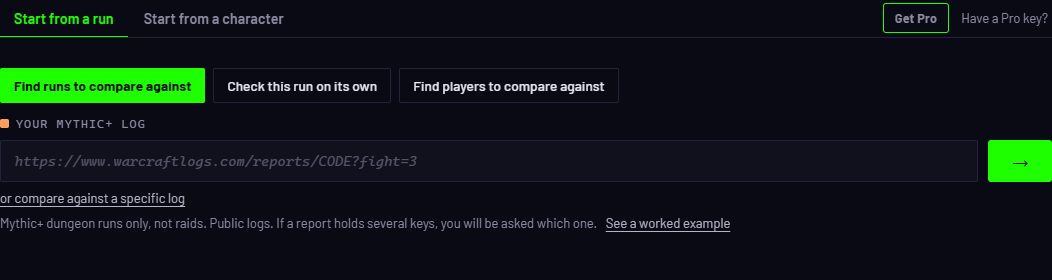
Find runs to compare against. Paste one Warcraft Logs link and it lists runs of the same dungeon at your key level, with filters for group setup, gear, time and whether the timer was beaten.
Compare against a specific log. When you already have the run in mind.
Check one run on its own. When there is nothing to compare it to yet: the same page, without the other side.
Start from a character. Find players of your spec on your gear, or open your season.
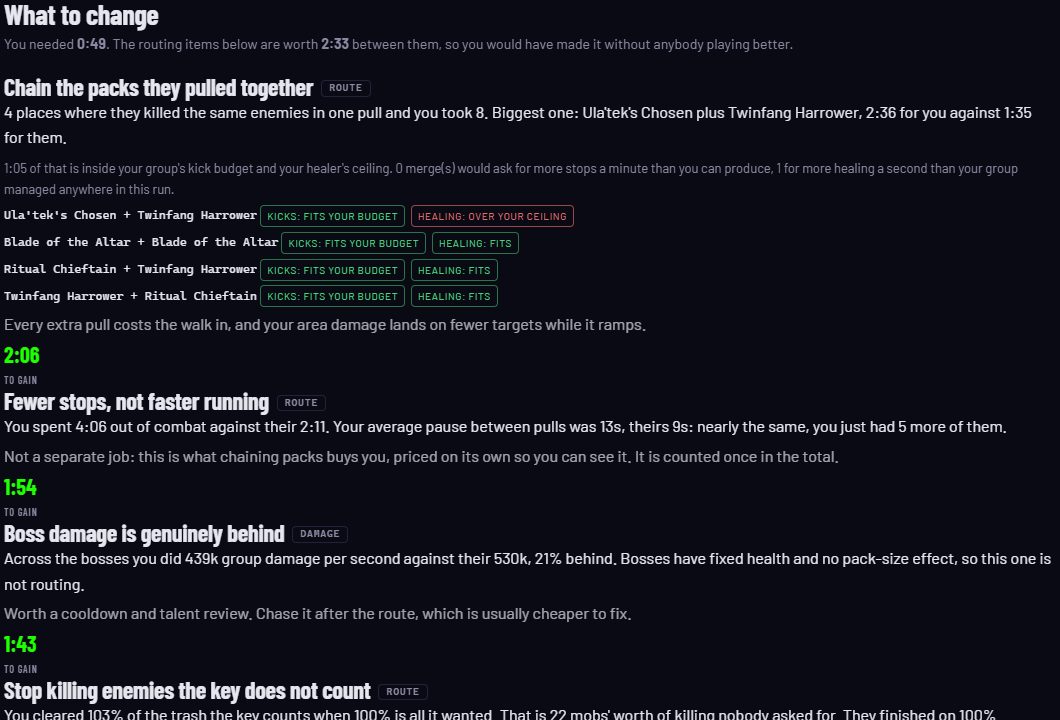
 The verdict, and what to change
Every comparison opens with one sentence on where the time went, then a ranked list: chain these packs, stop killing what the key does not count, stop more of this cast, purge that buff, stand in less, the deaths and what they cost, the healer's mana, Bloodlust on the wrong pull.
Each item is priced in seconds where seconds can be honest, and overlapping items are not summed twice. A merge is tagged with whether your group's kicks and healer could have carried it.
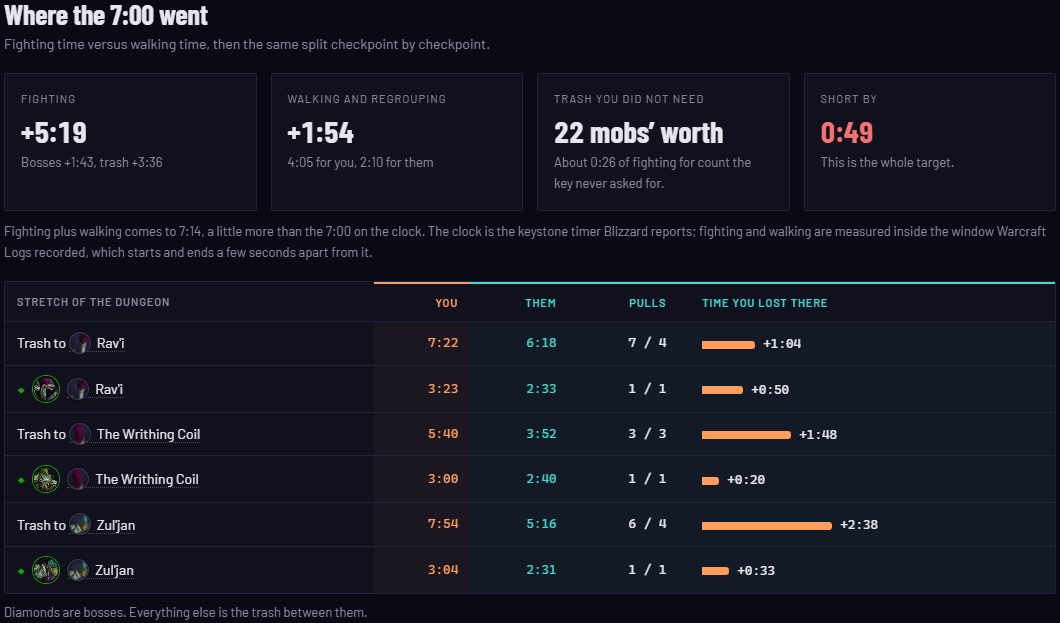
 The time budget
The clock is Blizzard's keystone timer, not the log window. Fighting time is split into bosses and trash, walking time is what is left, and the trash you killed beyond 100% of the count is priced at your own trash damage rate.
Each stretch between bosses gets its own line, so you can see whether the minutes went on the first half or the last.
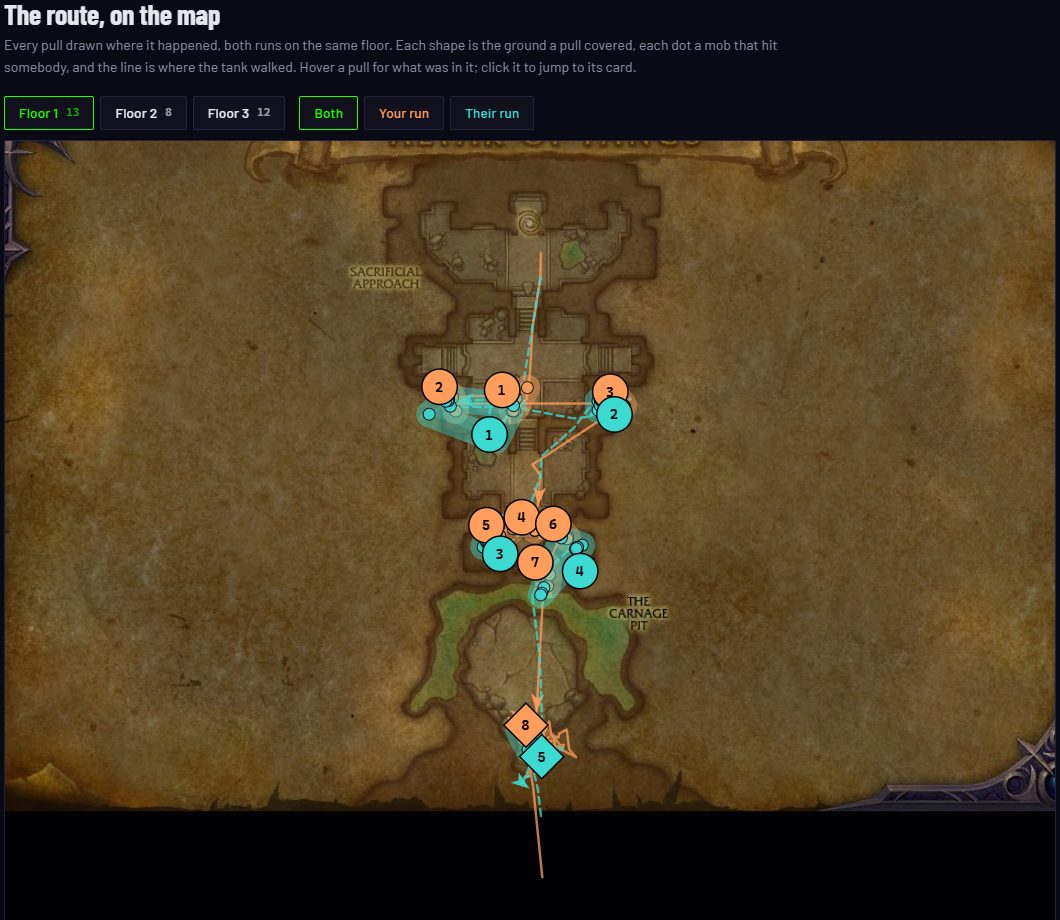
 The route, on the game's own map
Every pull is drawn on the dungeon's floor art where it happened, with the tank's path as a line, a dot per mob that swung at somebody, and numbered badges that match the pull cards. Both runs go on the same floor, so a pack one group chained and the other split is visible before any table.
Positions come from the log itself: every event carries where its source stood. The floor images are the client's own map tiles.
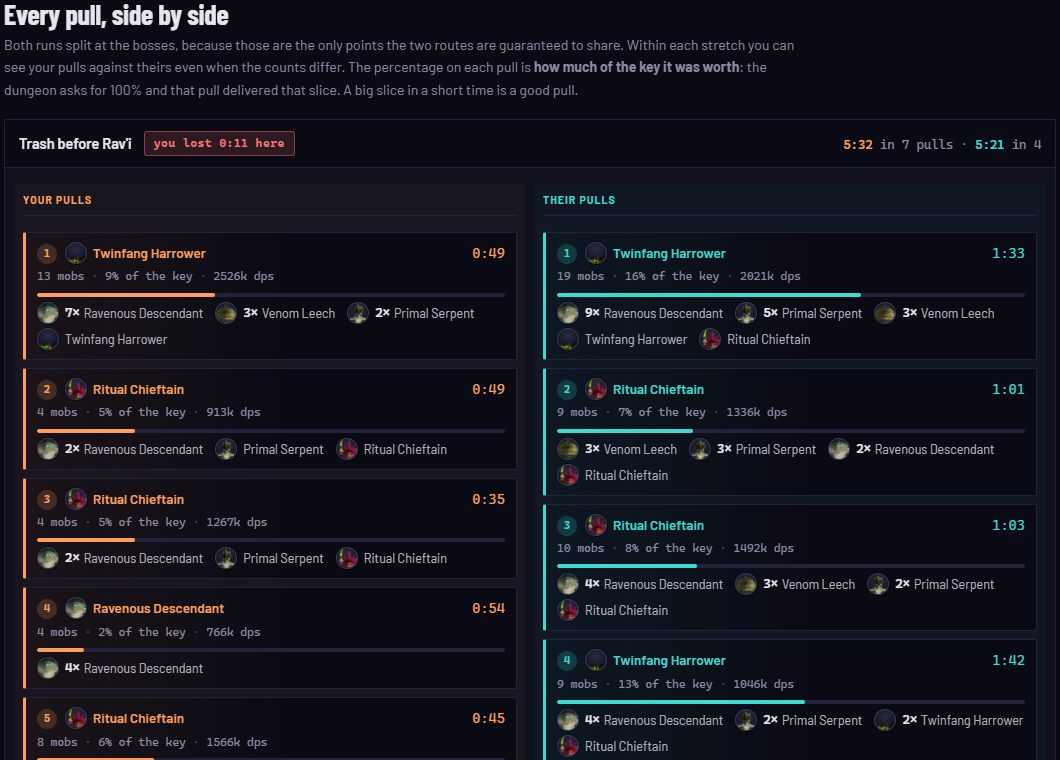
 Pull cards and pack merges
Each pull is a card: the mobs in it with their faces, how much of the key it was worth, how long it took and the group's damage per second on it. Pulls are lined up boss by boss, so the trash between two checkpoints sits side by side even when one group took seven pulls and the other four.
Where the other group killed the same enemies in one pull, the merge is named and timed wall to wall.
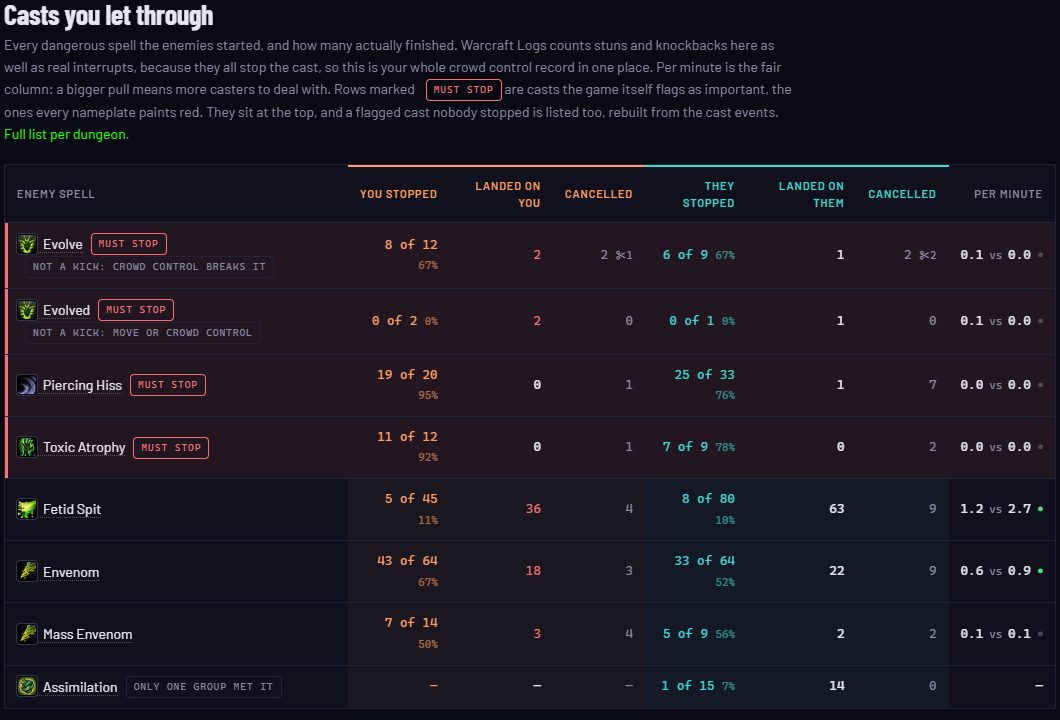
 Interrupts, rebuilt from events
Warcraft Logs' interrupt table is blind to crowd control, so a stun, an incapacitate or a knock that cuts a cast short is lost there. Keystone Delta reads every enemy cast start and matches interrupt events and control auras to the caster inside its window; a channel broken by a Roar counts, a channel that ran its course counts as landed, and a cast that ended because the caster died is a cancel, not a save.
Casts the game itself flags as must-stop sit at the top. Each ability says what answers it, from Method's tracker: a kick, crowd control, moving out of it, a purge, or nothing, because the caster is immune.
A flagged spell with no cast bar (the buff a mob gains when its channel finishes, Evolved from Evolve) is never a row: the cast that produced it says what it gained.
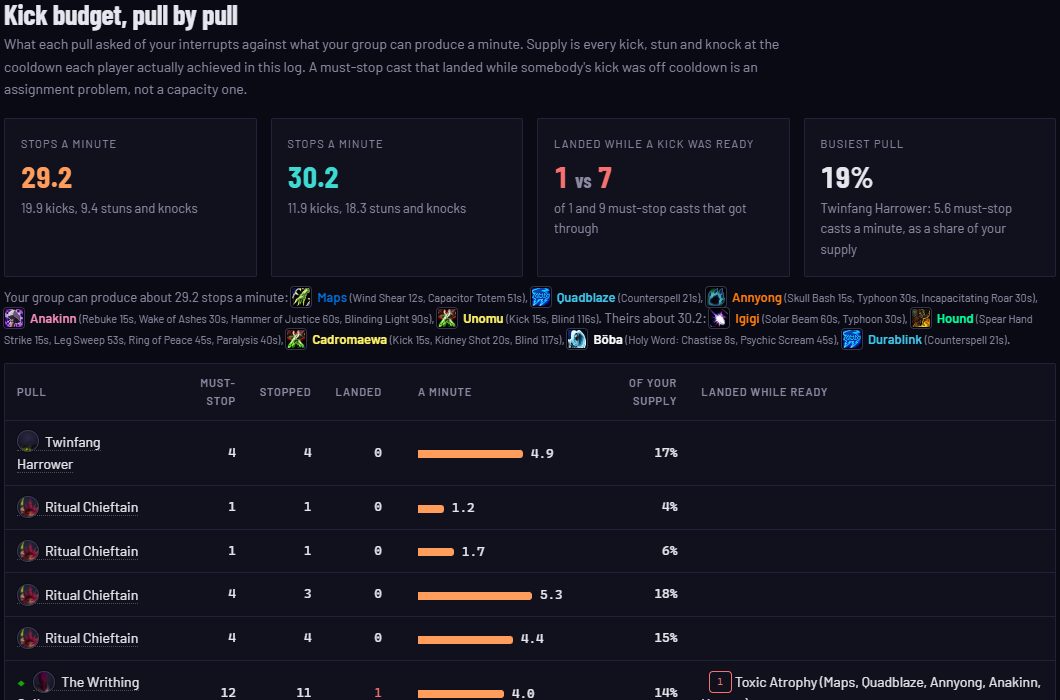
 The kick budget
Supply is every kick, stun and knock the group brought, at the cooldown each player actually achieved in the log. Demand is the must-stop casts each pull started, per minute.
A must-stop cast that landed while somebody's interrupt was off cooldown is listed with who had it ready, which separates an assignment problem from a capacity one.
Supply is the ceiling, not the tally: a button counts when the log shows a press, when the player's own talent build took it, or when every player of that class has it. Anything unproven is left out, so the number is a floor. What was carried all run and never pressed once is called out on its own, because a button nobody used and a button nobody had are different answers to “we did not have the interrupts for that pull”.
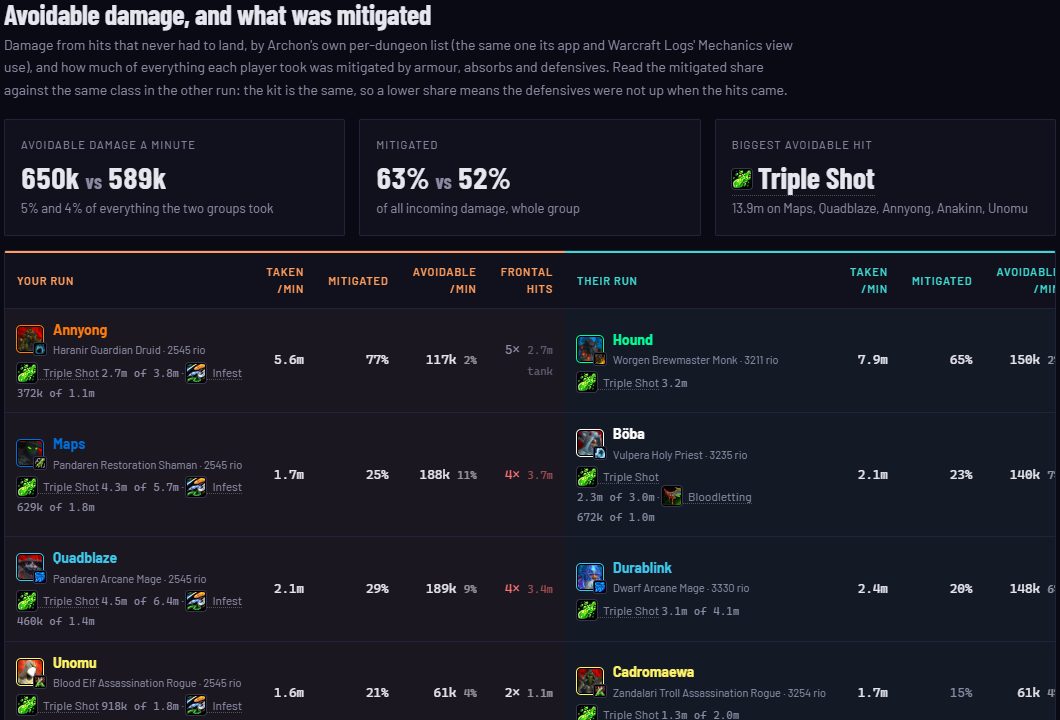
 Avoidable damage, split per hit
Which hits were avoidable comes from Archon's per-dungeon lists and Method's flags. Whether this hit was avoidable comes from the shape of the events: a run of ticks at a steady beat on one player is standing in it, several hits within half a second are one mechanic resolving on stacked people, and a run that starts right after an enemy cast aimed at that player is theirs to take.
Only standing and overlap count against a player. Mitigated damage is shown beside it, and frontal cones get their own column: for everyone but the tank, how many times a cone caught them, as stretches of contact rather than ticks.
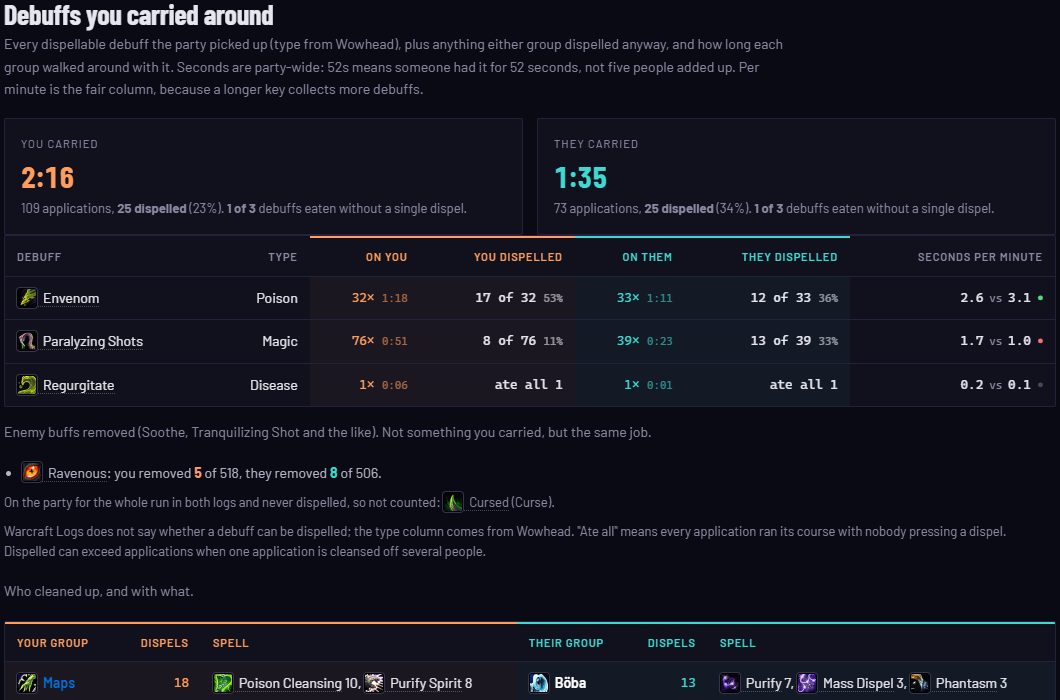
 Dispels and debuffs
Every dispellable debuff the party picked up, typed from Wowhead and Method, how long the party carried it, who removed it with what, and which debuffs ran their course with nobody pressing anything.
Enemy buffs removed with Soothe or Purge are listed separately, because they are the same job on the other side.
 The healer
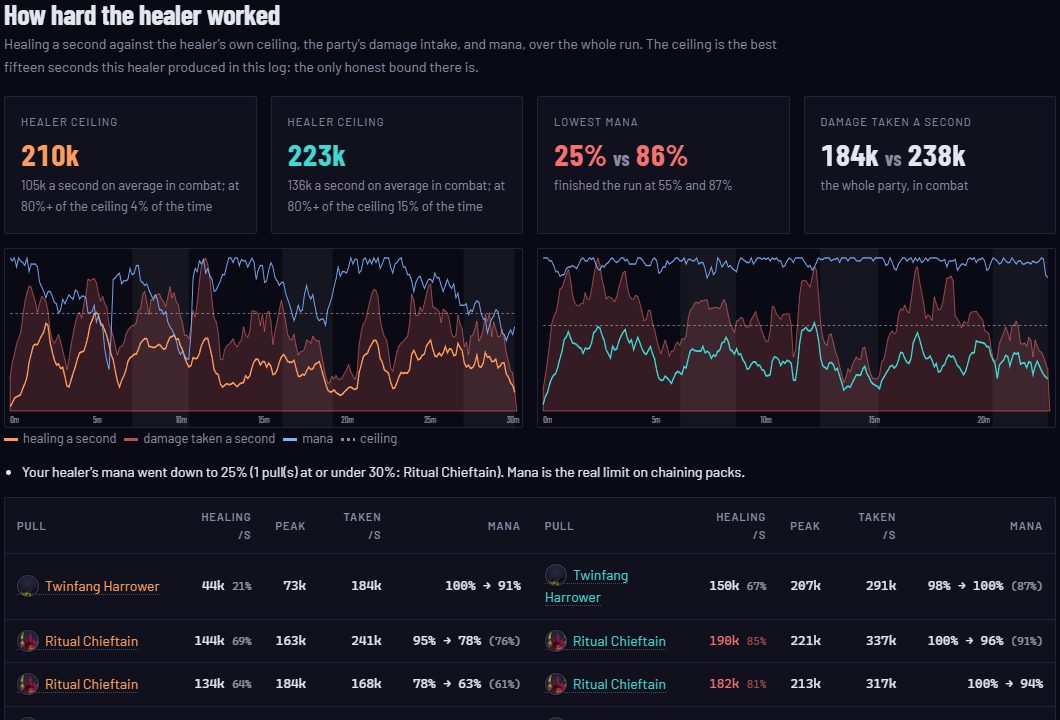
Where the healing went, tank against self against DPS, read against where the damage came in, which is what tells tank sustain from wrong-target healing.
Then healing a second against the healer's own ceiling, the party's damage intake and mana, pull by pull and as a chart, so the pull that emptied the mana bar is named.
 Every death, and what it cost
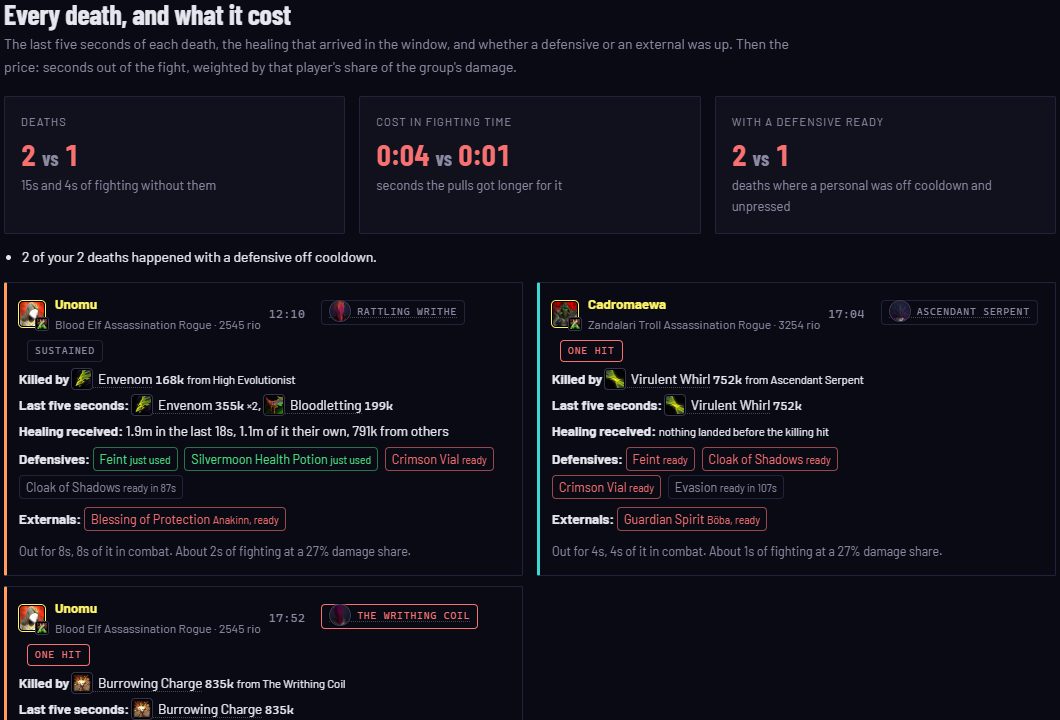
The killing blow, the last five seconds of damage, the healing that arrived in the window, and every defensive and external that was ready or on cooldown at that moment, from the player's own cast history.
The cost is seconds out of the fight weighted by that player's share of the group's damage; a tank or healer death stalls the whole pull and is said so rather than priced.
 Cooldowns, Bloodlust and boss heals
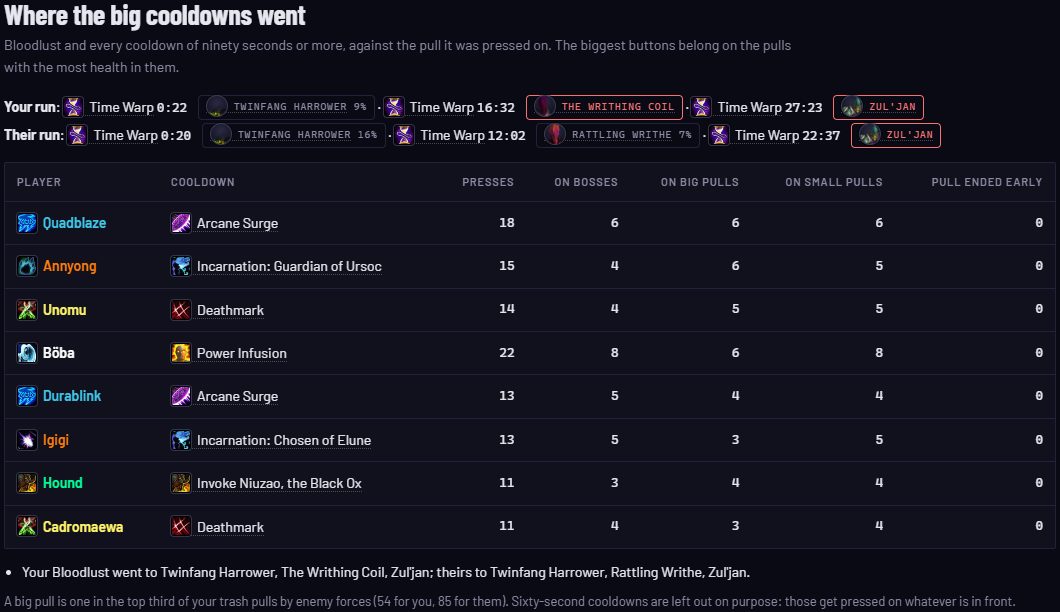
Every cooldown of ninety seconds or more against the pull it was pressed on, and whether that pull was a boss, a big pull or a small one. Bloodlust on a small pull, or out of combat, is named.
What a boss healed back is damage the group did twice. It is priced at the group's own boss damage rate and filed as an answer, not a damage problem: a kick where the heal is a cast, a purge where it is a Magic buff, and a mechanic to deny where no button removes it.
 Damage that survives a slow key
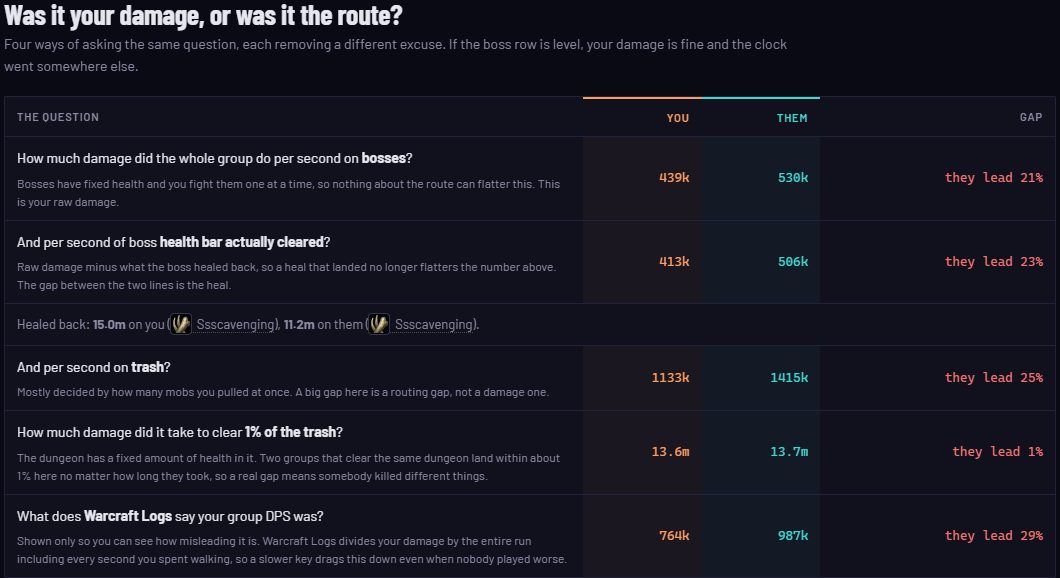
Four questions instead of one meter: damage per second on bosses, which no route can flatter; per second on trash, which is mostly pull size; damage per 1% of the trash count, which two groups clearing the same dungeon land within a percent of each other; and what Warcraft Logs says, shown so you can see why it misleads.
 Players, and players like you
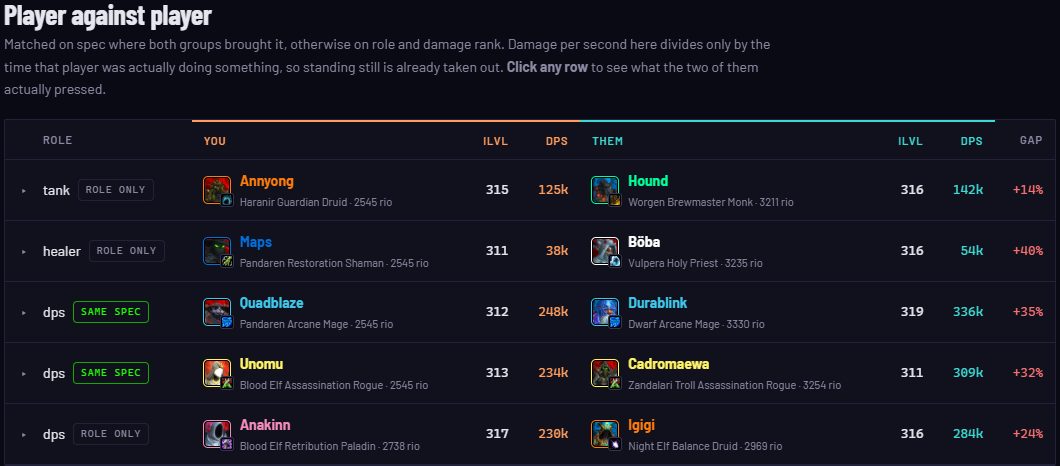
Players are matched on spec across the two runs, then on role, and a click opens both cast tables: every ability with casts a minute and share of casts, so the difference between two Arcane Mages reads as which buttons, not how many.
Pick yourself in a log and it searches the public rankings for players of your spec at your key level on your gear. The matchup compares the two of you: damage per active second and per trash point, casts a minute, kicks, dispels against what your kit could dispel, deaths, damage taken by ability, mitigation, frontal cones, cooldown presses against possible presses.
 Gear, enchants, gems and talents
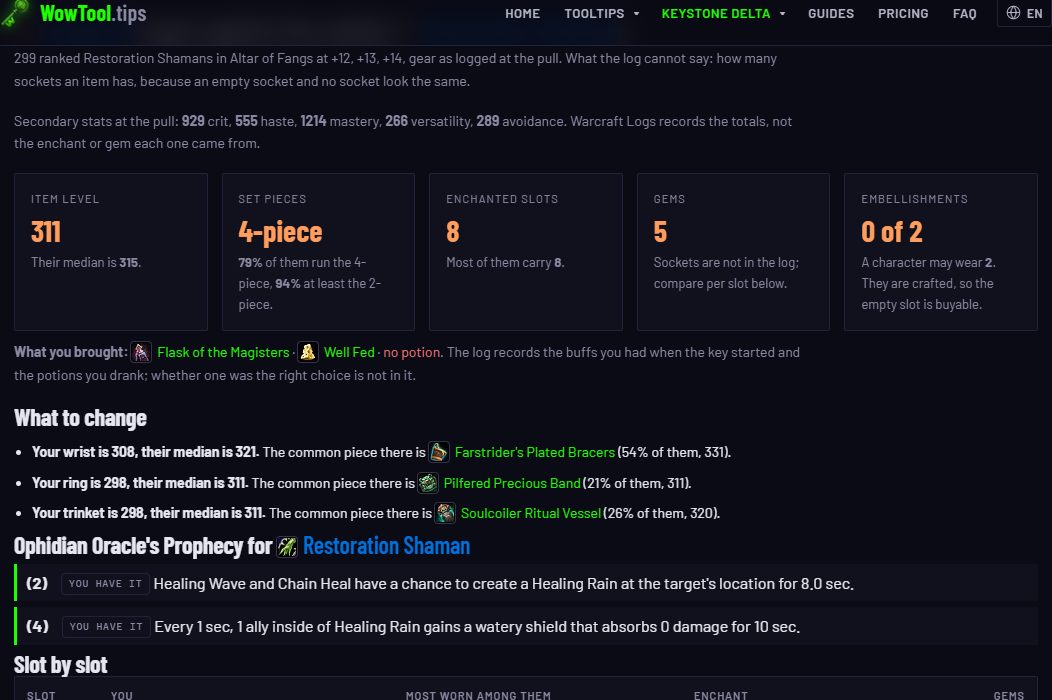
Your gear against what ranked players of your spec actually run at your key level in that dungeon: set pieces with the bonus text, enchanted slots, gems, embellishments and item level, slot by slot beside the item most of them wear.
The talent tree is drawn the way the game draws it. Brightness is how many of them take a node, the number under it is the share, a green border is one you take and a red one is a node seventy per cent of them take and you do not. Every icon is a spell link with its tooltip.
The comparison costs no extra reading: those ranked runs were already fetched for the player search, and your own build comes from one two-point read of the pull.
 Flasks, food, potions and runes
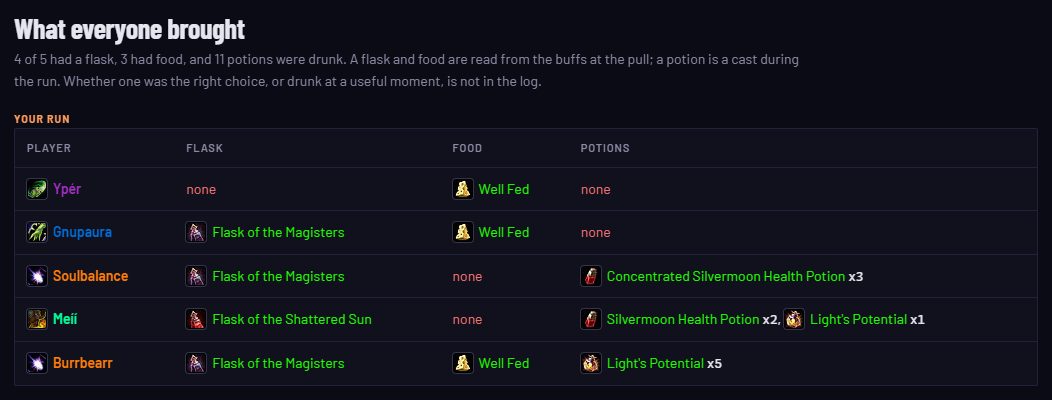
Warcraft Logs never labels a consumable, so the client's own item tables do it: a flask, food and an augment rune are read from the buffs each player had when the key started, a potion from the casts during the run. There is no list of spell names to keep up to date.
Both groups are shown player by player, so "four of us flasked and none of us ate" is a line rather than a guess. A consumable the party passed round counts as yours, and the reverse case is a finding: something two or more of the others used and you never took.
What the page does not claim is whether the flask was the right one for your spec, or the potion well timed. That is not in the log.
 What you bring, over a season
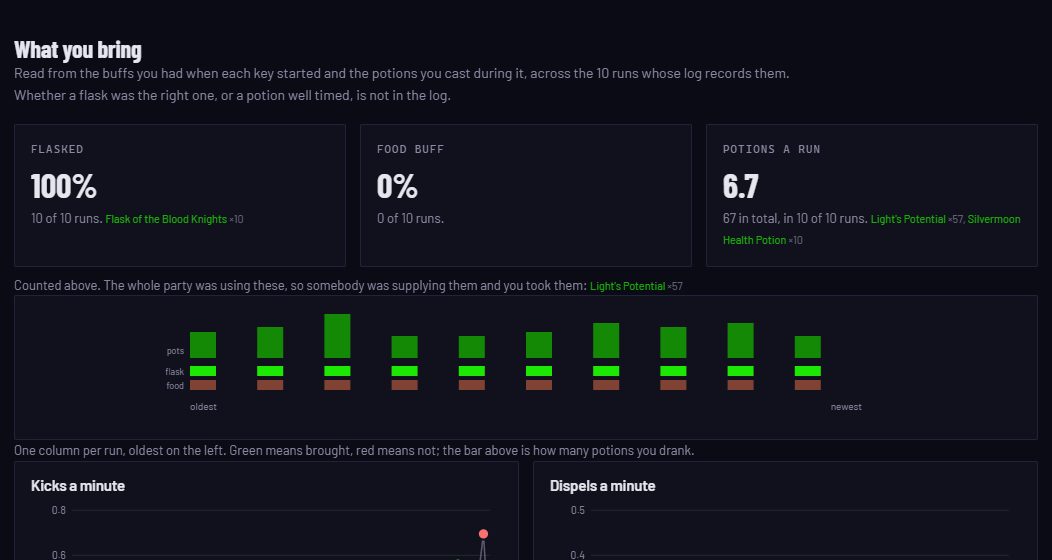
The same reading across every logged run of your season: how often you flasked, how often you had food, potions a run, and a column per run so a habit that slipped is visible rather than averaged away.
It is free to compute. The season batch already asks Warcraft Logs about those fights, and the hour is charged per query rather than per field, so the answer rides along with the kick and death habits.
 Your season
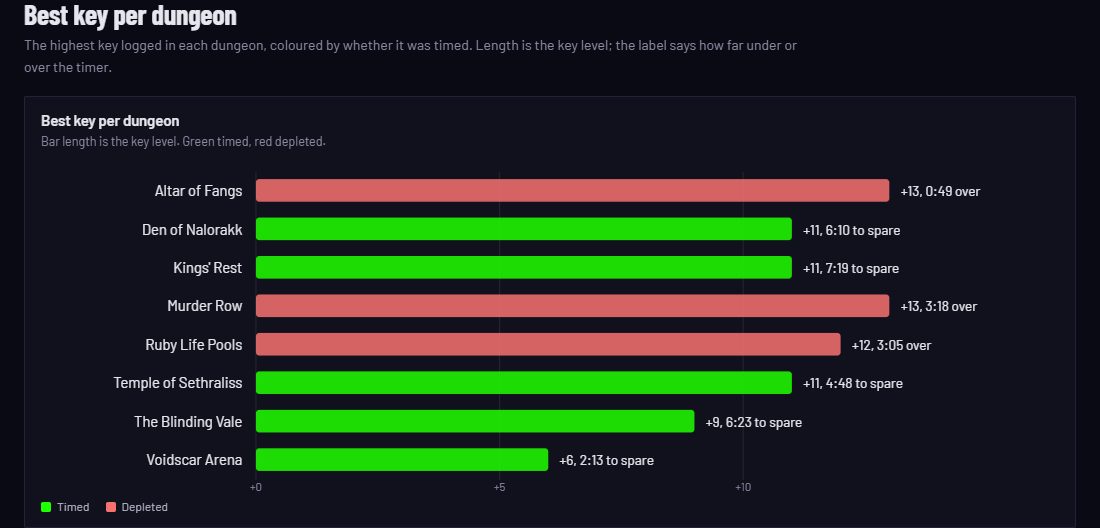
Every logged run of the season for one character: best key per dungeon with the margin to the timer, score over time, runs per week, which dungeons are still untimed at your level.
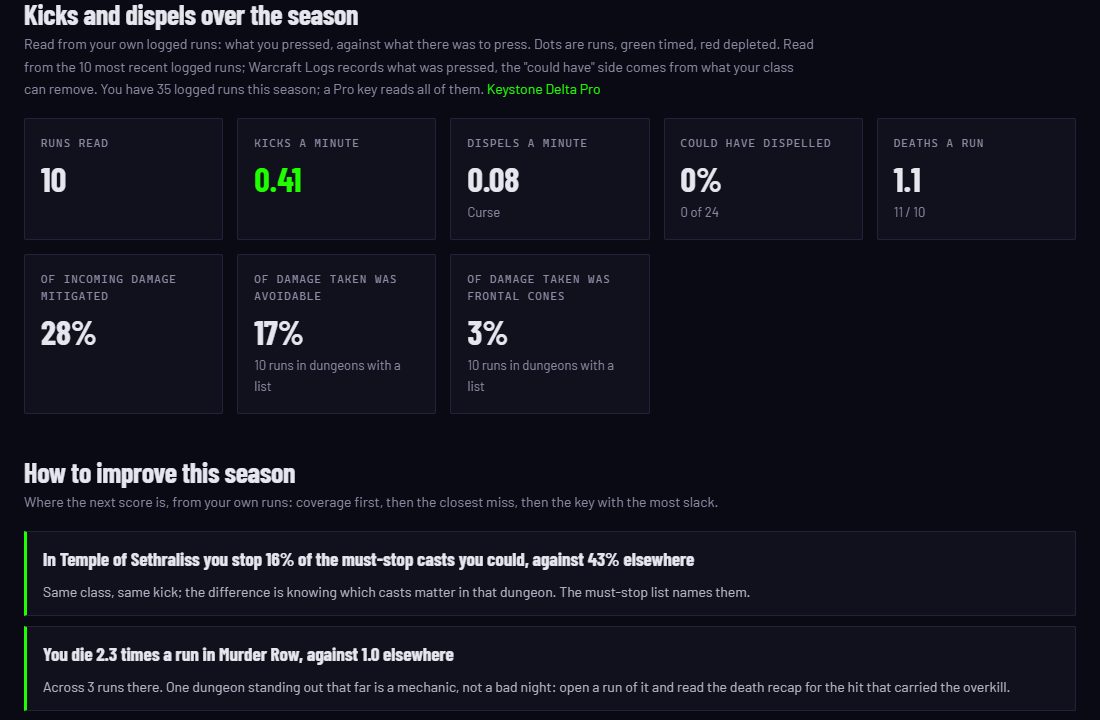
Season habits are read from your own runs: kicks and dispels a minute, must-stop casts stopped and landed with the caster's face, deaths a run, avoidable share, frontal share, each as a chart, with the advice that follows from them. Raider.io score sits beside it.
 Must-stop casts, per dungeon
A page per season listing the casts the game itself flags as important in every dungeon, with the boss or mob that casts them, its face, and whether it is a hard cast or a channel.
 Share links, cards and PDFs
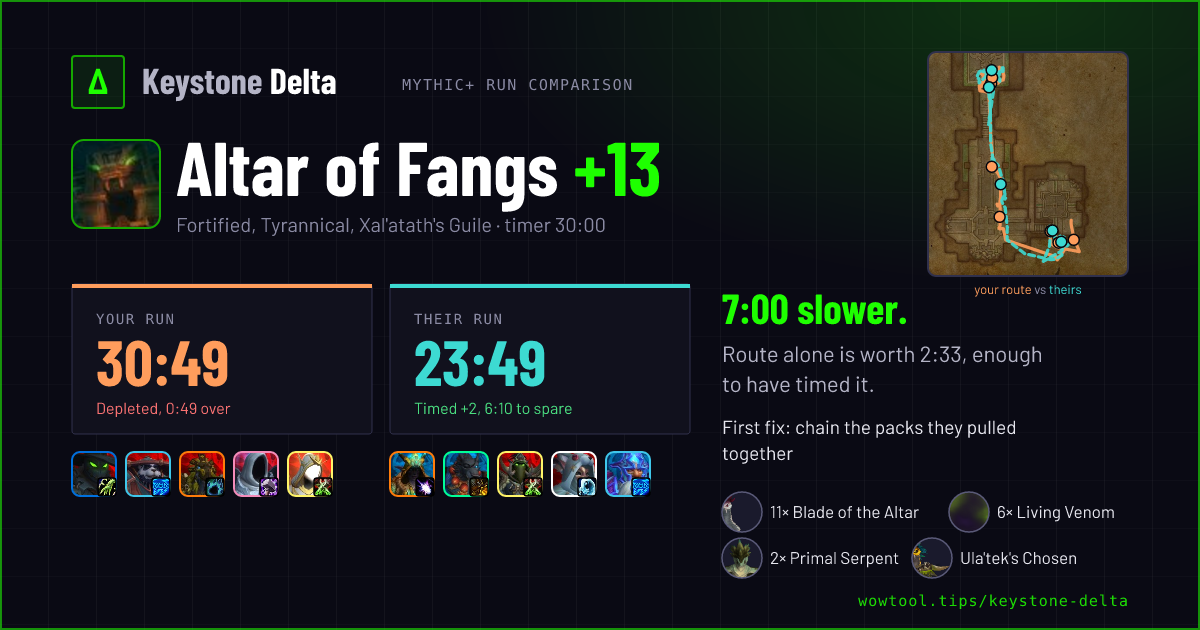
Every comparison, run check, matchup and profile has a permanent link that unfurls in Discord and on Twitter with a card drawn for it: both times, the verdict, the first fix, the route on the map, the faces.
A PDF of any page prints the page itself, portraits and charts included. It is the whole analysis, so a free reader renders one an hour and a Pro key raises it to thirty.
 What player reviews added
Six reviews of real runs, each by a player reading his own report, changed these rules in September 2026. Every one is a rule, not a boss name.
- The list leads with the layer that broke. When deaths run far above the other group's or a tenth of the damage taken was avoidable, the survival items come first and a sentence says why; otherwise the seconds rank them.
- A suggestion's label carries what this group can take. Merges its own kicks, healing or mechanics rule out are shown beside the sum, not sold as it, and deaths are priced against the other group's deaths.
- Merge feasibility has a third axis: mechanics. An ability that fires on death or damage no button stops multiplies with the mob count and is solved by choreography, not by numbers.
- A boss healed to the finish is a healer item, not a damage one, and a boss that trades an immunity is named under the boss-damage line.
- A flagged spell with no cast bar is never an interrupt row; it is shown as what the cast gained. Spells every class cast belong to the dungeon and get their own panel: buff objects, offerings, floor effects, consumables.
- Kills worth nothing to the count bar are counted per pull, and a timed key is never called unfinished because Warcraft Logs' count fell short.
- Stops are read as longer or more, not one word for both, with the pauses after deaths measured separately.
- Every death card quotes Method on the killing ability, or on the mechanic that makes it.
- The items and the difference now add up. What the items do not explain is listed as its own line, the same work done slower, so no item is read as bigger than its share.
- A merge carries two prices, one at each group's kill rate, because the merged pull was theirs and slower hands make the same merge save less.
- A damage column is declared, not corrected, for the buffs around it: an external damage cooldown one side handed out and the other did not is named above the player table.
- Every death says how the damage arrived, one spike or something that built up, and what single change would have stopped it: not standing in it, a defensive that was ready, or an external somebody had up.
- The standing group buffs the two compositions did not share are named beside the damage columns, with a percentage only where one exists and applies to every hit.
- Every death is read over its real window rather than Warcraft Logs' short recap, so the card can say how big the player's health pool was and how much of it arrived: six deaths in one run took half as much again as the player had health, which no single button covers.
- Each death says where the healer was standing, measured from their last cast, and whether they were alive, in range and what they were pressing. An external whose owner was out of range is never offered as a press that was passed up.
- A healthstone or a health potion is its own step, priced from what one restores on that player in that run, and only asked for when they are proven to have carried one.
- Every burst, healing and Bloodlust cooldown of 30 seconds or more is priced as presses against the windows the run allowed on its base cooldown, on the run check, the matchup and the season. A talent that shortens one reads as more presses than windows, never as a fault, so the share is a floor.
- The buffs a player keeps up as part of the spec (Bone Shield, Shadowform, Slice and Dice, the forms, a Shaman's shields) and the raid buff their class brings are read as uptime over the whole fight window, per player in a run and over a season. A buff the player's own build did not take is never a finding, and one the build may not carry says so.
- Over a season, every defensive the player's own build carried is listed with the runs it was pressed in at all, and the runs with a death and no defensive pressed are counted. On the players screen, the per-spell table against the ranked is read as two findings: buttons they press far more often than you, only where your build proves you had them, and one button they skip that you press, worded as a question.
- A player who was feared, stunned or otherwise held for the whole stretch a press could have landed in is never told a defensive was ready. The debuffs on the victim are read for every death and matched against the game's own loss-of-control table, and such a death is named after the aura and left out of the preventable count.
- A wipe is the group down, not five deaths. It is found from the alive timeline, priced as the fighting after the last kill (every mob still alive resets; the kills before it still count) plus the run back, its re-pull is named, and its deaths are grouped under one card that says who went first and to what, how fast the rest followed, and what it cost. Deaths inside a wipe are not priced again, and the run-backs leave the stops item.
 Where the numbers come from
None of it is guessed; where a source is silent, the page says so.
- Warcraft LogsThe runs, the rankings and the character histories, through the public API.
- The game clientBlizzard's own must-stop flag, read in game and dumped per patch.
- ArchonAvoidable and interruptible lists per dungeon.
- MethodThe ability tracker: what each enemy ability is, and which casters cannot be controlled.
 Raider.ioDungeon timers, scores and character portraits.
 WowheadSpell and dungeon icons, tooltips and dispel types, through our own proxy.
 Fifteen languages
The tool page, the profile page and the Mythic+ guides are in Turkish, Indonesian, Filipino, Serbian, Hindi, Thai, German, French, Spanish, Portuguese, Italian, Russian, Korean and both Chinese scripts. Results are English, because spell and dungeon names are.
See all of it on a real pair of logs
The tool opens on a worked example, two Altar of Fangs +13 runs, so every panel above can be read before you paste anything.
Open Keystone DeltaFrequently asked questions
Is any of this behind a paywall?
No. Every reading on this page is free and identical on every plan. Pro and Guild buy capacity: your own Warcraft Logs client so you never queue, your whole season instead of the last ten runs, your own PDF budget, and a guild roster page. The analysis is the same.
Does it work on a depleted key?
Yes, and that is the run worth reading. The comparison shows where the seconds went; the run check reads one log on its own; the season profile counts depleted runs too, because a week of depleted runs at one level is a key being pushed, not a bad week.
Where do the avoidable and interruptible lists come from?
Three sources, used together: Blizzard's own must-stop flag read from the game client, Archon's per-dungeon avoidable and interruptible lists, and Method's ability tracker, which flags every enemy ability as interrupt, stop, avoid, frontal, buff or debuff and marks which casters are immune to crowd control. Warcraft Logs itself carries none of these.
What does a Warcraft Logs parse not tell you that this does?
A parse divides your damage by the whole run, so a slow key deflates every player, and it says nothing about the route, the kicks, the healer's mana or why someone died. Keystone Delta measures the run against its own timer and against a second run of the same dungeon, pull by pull, and prices every finding in seconds.
Can it tell me whether my gear is the problem?
It can tell you what differs. Your set pieces, enchanted slots, gems, embellishments and item level are compared with the ranked players of your spec at your key level, and the run comparison names the slots where the other group had an enchant and you did not. What it cannot see is how many sockets an item has, because an empty socket and a socketless item look identical in a log.
Does it check flasks, food and potions?
Yes, for every player in both runs, and across a whole season for one character. A flask, food and an augment rune are read from the buffs at the pull; a potion is a cast during the run. Whether the flask was the right one, or the potion well timed, is not in the log and is not claimed.
Can I see my talent build against everyone else's?
Yes, drawn as the in-game tree. Every node carries the share of ranked players who take it, your own picks are outlined, and a node most of them take and you skip is marked. The hero tree gets its own panel, because a hero tree has its own coordinates in the client data.
Does it work for a healer or a tank?
Yes, and the readings follow the role. A healer is compared against the healing rankings rather than the damage ones, the matchup opens on healing per minute and overheal, and the healer panel prices the mana, the damage that came in and where the healing went. A tank pair opens on damage taken and mitigation. Every player also gets the kick, dispel, death and cooldown accounting.
What can it not answer?
Whether a player was in range or line of sight, how many sockets an item has, whether a consumable was the right choice, what an object handed out by the dungeon did for the group, and anything about a private log. Each of those is said on the page where it matters rather than guessed at.
How much of the log does it read?
About 120 Warcraft Logs points a run, once: every table it needs plus the events for interrupts, crowd control, deaths, enemy casts, positions and the hits on the avoidable lists. A run read once is stored, so a second reader of the same run costs nothing and waits for nothing.